

In fire detection and evacuation systems, the cable is the last element that should fail: it must keep carrying signals and messages even when the building is already affected by the fire. This is why fire-resistant cables carry standard markings on the sheath, harmonised at European level, which let designers and installers immediately recognise how the cable is built.
The four most common codes are FG29OM16, FG29OHM16, FTS29OM16 and FTE29OHM16. They look alike, but they identify two different technical solutions. Understanding what sets them apart is the first step towards choosing the right cable for every system.
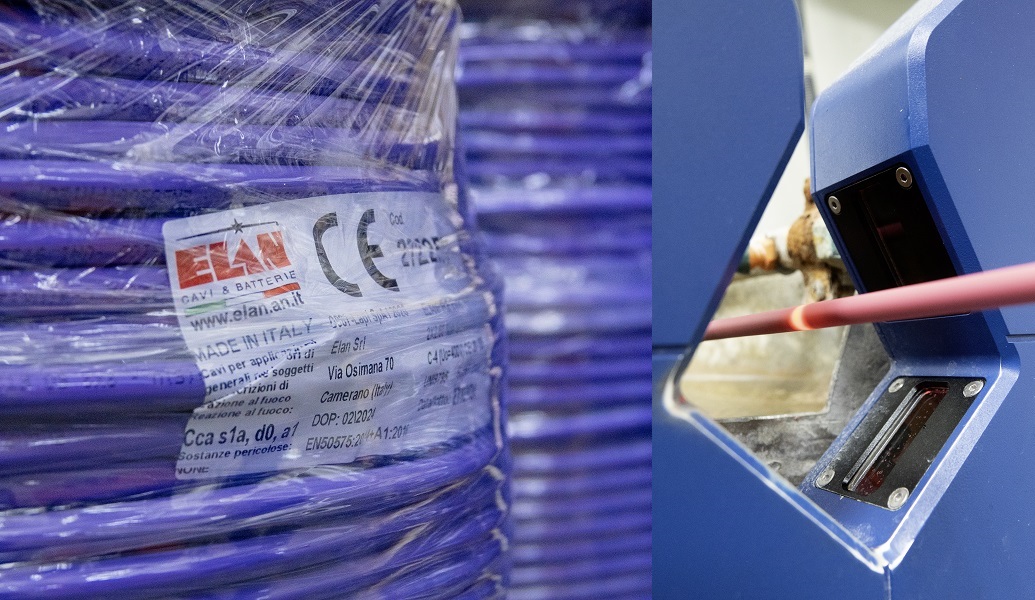
The regulatory framework
Three references define what a fire-resistant cable must guarantee and how it must be declared.
- Construction Products Regulation (CPR). Requires every cable manufacturer to declare the product’s reaction-to-fire class, known as the Euroclass, regardless of how the cable is built.
- EN 50200. Sets out the test methods used to verify the fire resistance of cables designed for fire safety systems, that is, their ability to keep working during a fire.
- CEI 20-105. Introduces the standard markings that distinguish the different construction technologies and that must be printed on the cable.
Industry standards evolve together with production techniques and market needs. It is therefore always good practice to check the current version of each reference at the design stage.
Two technologies, four codes
Today, fire-resistant cables are based on two construction technologies, both compliant with fire safety standards. Each has its own pair of codes, in unshielded and shielded versions.
| Technology | How the cable is built | Unshielded | Shielded |
|---|---|---|---|
| Ceramifiable silicone | Conductor insulated only with a G29 silicone-based elastomeric compound | FG29OM16 | FG29OHM16 |
| Glass/mica + E29 compound | Conductor wrapped in glass fibre/mica tape and insulated with an E29 cross-linked compound | FTS29OM16 | FTE29OHM16 |
The difference is substantial. In the first case, fire protection relies on the silicone insulation, which turns into a ceramic layer when exposed to fire. In the second, the main barrier is the glass/mica tape wrapped around the conductor, with the cross-linked insulation adding a further layer.
How to read the code
Each part of the code describes an element of the cable. Reading it in full tells you how the product is built, without opening the technical data sheet.
| Part of the code | What it means |
|---|---|
| F | Flexible stranded conductor |
| G29 | Ceramifiable silicone elastomeric insulation |
| T (in FTS / FTE) | Conductor wrapped in glass fibre/mica tape |
| E29 | E29 cross-linked compound insulation |
| O | Multicore cable, with several cores laid up together |
| H | Shielded cable |
| M16 | Outer sheath in flame-retardant thermoplastic compound with low emission of smoke and toxic gases |
The rule of thumb is simple: G29 means ceramifiable silicone, T and E29 mean glass/mica technology with cross-linked insulation, H means the shielded version.
Why Elan only manufactures FTS29OM16 / FTE29OHM16 cables
Elan has chosen to offer only the glass/mica technology with E29 insulation, because it believes this is the one that brings the most benefits to installers and designers, partly thanks to the electrical properties of the materials used.
It is also the more demanding technology to manufacture. The process requires precision at every stage:
- Glass fibre/mica tape is wrapped around every section of the conductor, since this layer is the main barrier against fire.
- The wrapped conductor is extruded into the insulating sheath.
- The conductors are laid up together and, where required, shielded.
- A second extrusion applies the flame-retardant outer sheath.
Careful processes and quality control are what allow a fire-resistant cable to deliver its declared performance over time.
ELANFIRE: the certified fire-resistant cable range
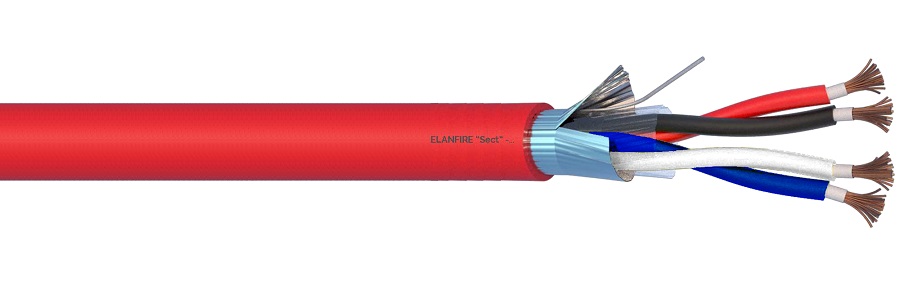
The ELANFIRE range includes signal cables for fire detection and EVAC cables for voice evacuation systems. All products in the range meet the same requirements.
| Requirement | ELANFIRE |
|---|---|
| Reaction-to-fire class (CPR) | Cca-s1a, d0, a1 |
| Fire resistance | EN 50200 PH120: operation for 120 minutes at 850 °C |
| Marking and construction | CEI 20-105 |
| Fire detection systems | UNI 9795 |
| Construction characteristics | CEI UNEL 36762 |
Made in Italy, ELANFIRE cables are chosen for their build quality, high mechanical strength and stock availability, always ready for immediate delivery.
Technical documentation always available
Declarations of Performance (DoP), certificates of conformity and technical data sheets for ELANFIRE cables can be freely downloaded from the website, on each product’s page.
Designing a fire detection or evacuation system and not sure which cable fits best? Get in touch with our technical sales team: we’ll help you choose the right solution.